-
About
Table of Contents
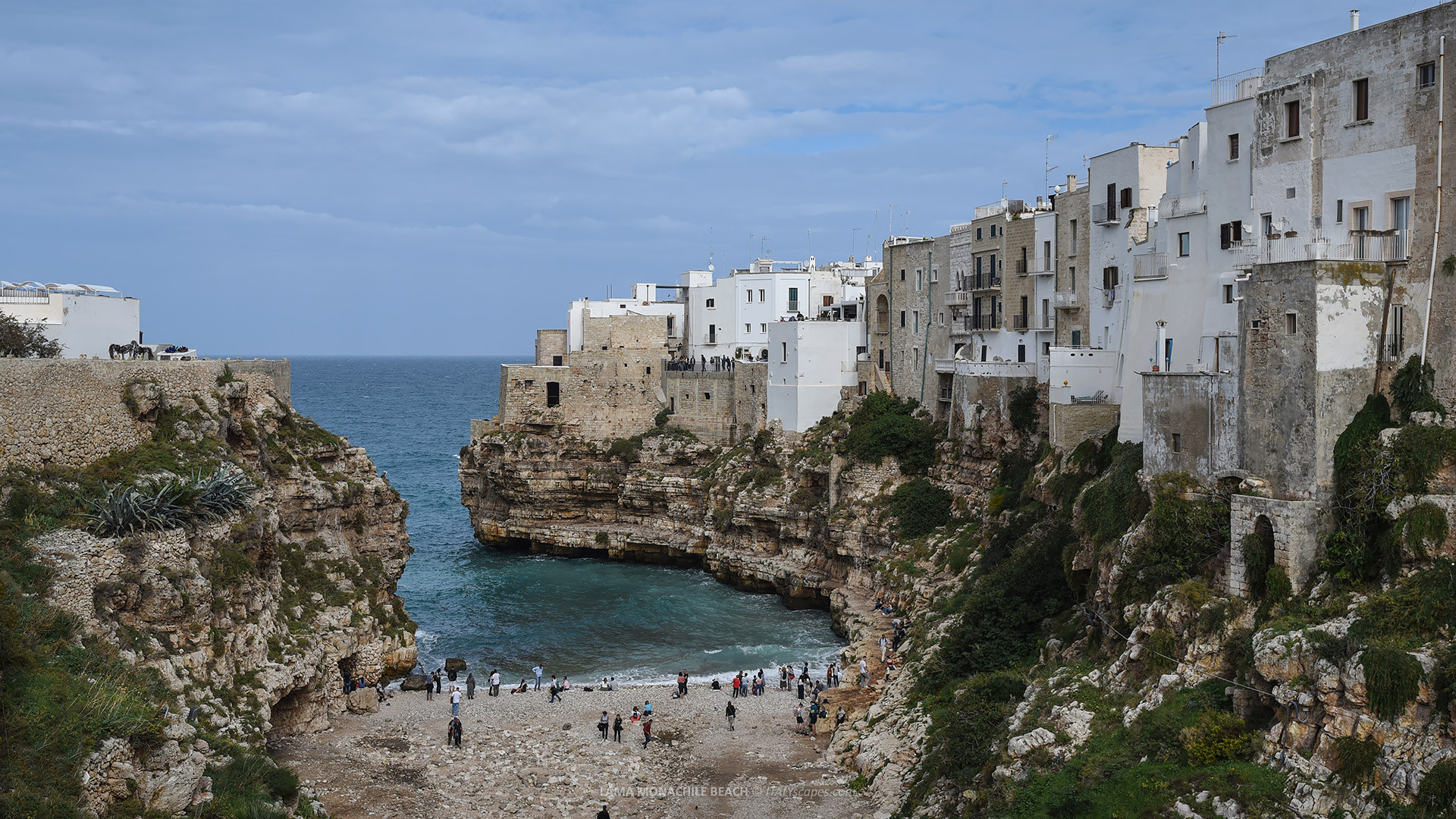
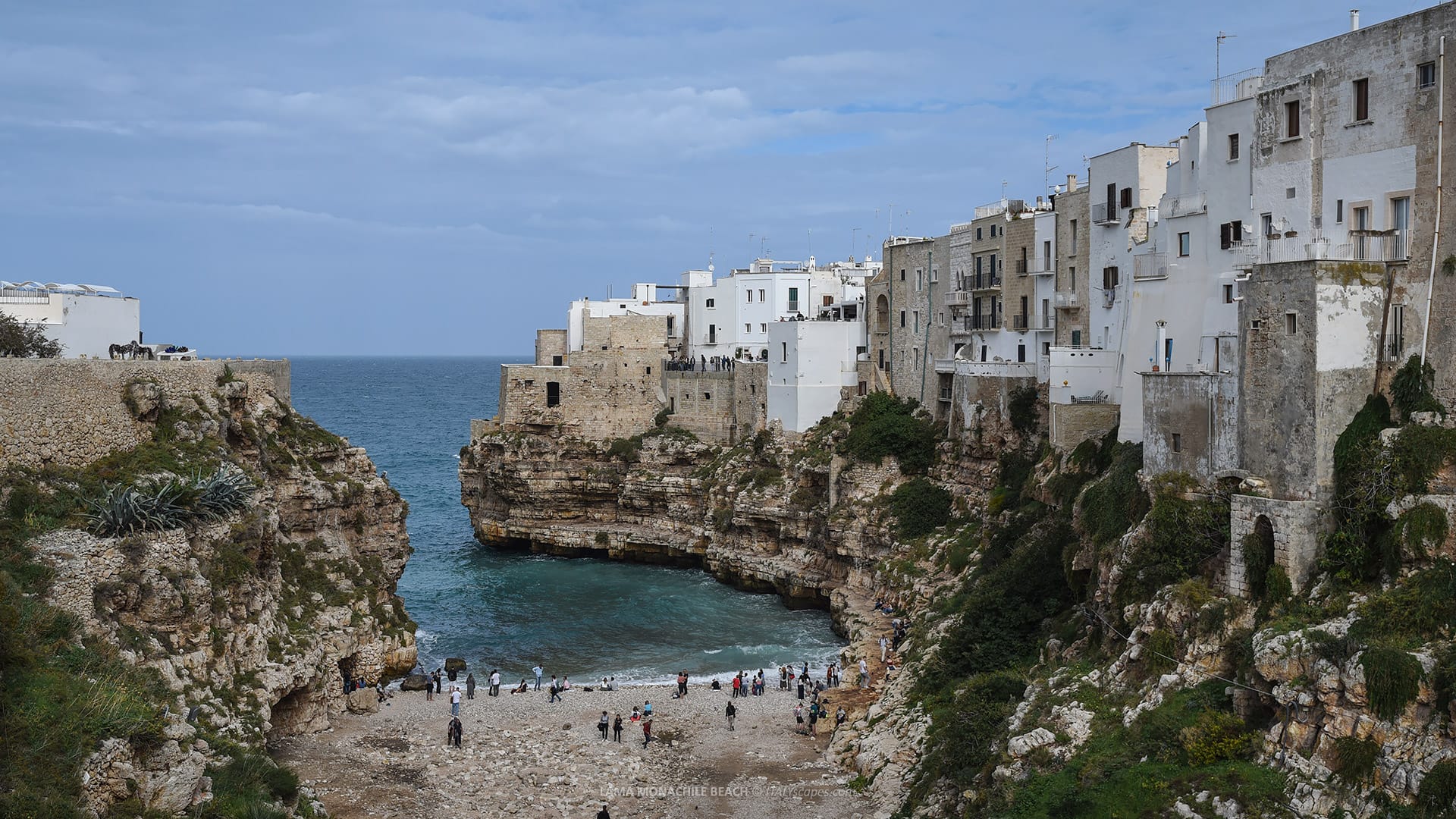
Lama Monachile Beach, also known as Cala Porto, is a small yet spectacular public beach located just steps away from the historic center of Polignano a Mare, in southern Italy’s Apulia region.
Set at the mouth of a narrow rocky ravine and framed by imposing limestone cliffs, the Lama Monachile Beach is famous for its crystal-clear turquoise waters, dramatic scenery, and the historic bridge that towers above it.
Recognized internationally as one of the most photogenic beaches in Italy, Lama Monachile has become a visual symbol of Polignano a Mare and of the Apulian coastline as a whole.
Its central location, combined with its natural beauty and historical significance, makes it a must-see destination for travelers exploring the Adriatic coast.
The beach is free to access, awarded the Blue Flag for water quality, and regularly hosts international sporting events, reinforcing its reputation as both a cultural and natural landmark.

Short History of the Lama Monachile Beach
The history of Lama Monachile Beach is closely tied to the strategic importance of Polignano a Mare throughout antiquity and the Middle Ages.
The narrow inlet that opens onto the Adriatic Sea was originally carved by seasonal rainwater flows, known locally as lame, which gave the beach its name. Over time, this natural corridor became a crucial access point between the inland settlement and the sea.
One of the most distinctive historical elements of the beach is the stone bridge that spans the ravine above it. This structure dates back to Roman times and formed part of the Via Traiana, an ancient consular road commissioned by Emperor Trajan in the early second century AD.
The road was designed to improve connections between Rome and the main ports of southern Italy, significantly boosting trade along the Adriatic coast. The bridge allowed the route to cross the natural gorge safely, linking the urban center with coastal routes.
During the 15th century, under Venetian influence, Lama Monachile served as a small commercial harbor. Its sheltered position made it suitable for loading and unloading goods, particularly agricultural products and stone materials.
The inlet functioned as a maritime access point until larger ports gradually took over its role.
In the 18th century, during the Bourbon period, the area underwent structural modifications that gave the beach its present configuration.
The bridge, later known as Ponte Borbonico di Lama Monachile, was reinforced and adapted to accommodate increased traffic. A major restoration project carried out in 1997 preserved its historical appearance while ensuring modern safety standards.
The beach’s geomorphology still reflects its original function as a rainwater channel. During periods of intense rainfall, water from the upper parts of the town naturally flows into the cove, occasionally flooding the beach.
A notable event occurred on September 26, 2006, when heavy rains temporarily submerged much of the shoreline.
In recent decades, Lama Monachile Beach has gained international recognition.
It has held Blue Flag status for the quality of its waters and environmental management, and since 2008 it has been one of the iconic locations for the Red Bull Cliff Diving World Series, attracting elite athletes and global media attention.
Description of the Lama Monachile Beach
Lama Monachile Beach is relatively small, measuring approximately 40 meters in width, but its compact size only enhances its dramatic impact.
The shoreline is composed entirely of smooth white and gray pebbles, shaped over time by the constant movement of the sea. There is no sand, which contributes to the exceptional clarity of the water, as pebbles do not cloud the sea floor.
The water here is renowned for its transparency and vivid shades of blue and green, with excellent visibility even close to the shore. The seabed deepens quite rapidly, making the beach suitable for confident swimmers and popular among snorkeling enthusiasts.
Fish are often visible near the rocks, especially during calm sea conditions.
Towering limestone cliffs rise steeply on both sides of the cove, creating a striking natural amphitheater. These cliffs, topped by whitewashed buildings and balconies overlooking the sea, provide partial shade throughout the day.
As a result, the beach does not receive continuous direct sunlight, particularly in the early morning and late afternoon. This natural shading can be refreshing during the hottest summer months but also means that temperatures near the water may feel cooler.
Lama Monachile Beach is an entirely public beach with no permanent beach clubs or sunbed rentals directly on the shore. Visitors typically bring their own towels, umbrellas, and water.
Due to its fame and central location, the beach can become very crowded during peak summer months, especially in July and August. Early mornings and late afternoons are generally quieter and offer the best conditions for swimming and photography.
Above the beach, the historic bridge provides one of the most famous viewpoints in southern Italy. From here, visitors can admire the contrast between the white town, the rocky cliffs, and the intense colors of the Adriatic Sea.
How to Get to the Lama Monachile Beach
Lama Monachile Beach is easily accessible thanks to its proximity to the town center of Polignano a Mare and its well-connected transport links.
The beach is located approximately 800 meters from Polignano a Mare railway station, making it reachable on foot in about 12 minutes. Trains connect Polignano a Mare with major cities such as Bari, Monopoli, and Brindisi, making it a convenient stop for day trips.
From the railway station, exit toward Viale delle Rimembranze and walk south toward the historic center. Continue along this road, then turn left onto Via Pompeo Sarnelli. Follow the street until you reach Piazza Giuseppe Verdi, a small square near the edge of the old town.
From here, look for the pedestrian staircase that descends toward the coast. The steps lead directly down to Lama Monachile Beach, passing close to the historic bridge that overlooks the cove.
For visitors arriving by car, parking is available in designated paid areas near the town center, though spaces can be limited during the high season. From most parking areas, the beach can be reached on foot within a short distance.
Sources: -
Photos
-
Map
-
Reviews