-
About
Table of Contents
The Church of Santa Maria al Carrobiolo stands at Piazza Carrobiolo 8 in the historic centre of Monza, Lombardy. The religious complex developed from a medieval foundation established by the Humiliati and later became associated with the Barnabites, who still maintain a presence there. The church remains an active Catholic place of worship.
The Church of Santa Maria al Carrobiolo is particularly important for the survival of its medieval bell tower and brick perimeter walls, its 16th-century façade, and the rich decoration added during subsequent centuries. Its interior combines an older three-nave arrangement with paintings, frescoes, sculpture, stained glass, and architectural additions created under Barnabite patronage.
Among the principal artists represented are Simone Peterzano, Guglielmo Caccia known as Moncalvo, Andrea Porta, Giovanni Battista Grandi, Gerolamo Grandi, and Giovanni Antonio Cucchi. The building is especially notable for its 17th-century Lombard paintings and an extensive 18th-century fresco cycle devoted to the Virgin Mary and Saint Agatha.
The Church of Santa Maria al Carrobiolo belongs to a larger complex containing the Barnabite convent, cloister, historic library, and Teatro Villoresi. Piazza Carrobiolo lies only about one kilometre from Monza railway station, making the Church of Santa Maria al Carrobiolo one of the easiest historic churches to reach on foot from the city’s main transport hub.
Short History of the Church of Santa Maria al Carrobiolo
The Humiliati Foundation
The origins of the Church of Santa Maria al Carrobiolo date to 1232, when the archpriest of Monza authorised the Humiliati community dedicated to Saints Agatha and Mary to build an oratory devoted to God and the Virgin. The foundation became one of the principal Humiliati religious establishments operating in medieval Monza.
Construction of the church was completed around 1260, creating a religious complex that included the church, conventual buildings, and bell tower. It stood close to one of the entrances to the fortified medieval town and near the Lambro River, within an area connected with traffic entering and leaving the urban centre.
The name Carrobiolo is linked to a small carrobbio, a space where carts could stop, turn, or gather close to a town gate. Although later renovations transformed much of the complex, important medieval elements survive, particularly sections of the exposed brick perimeter walls and the original bell tower.
The Arrival of the Barnabites
A major change occurred in 1571, when Pope Pius V suppressed the Humiliati order. The decision was supported by Carlo Borromeo, Archbishop of Milan, during his broader programme of Catholic reform. The former Humiliati complex at Carrobiolo was subsequently assigned to the Barnabites, officially known as the Clerics Regular of Saint Paul.
The Barnabites began renovating the complex in 1573, adapting the medieval buildings to their religious requirements while preserving significant parts of the earlier structure. Their first novitiate at Carrobiolo was established in 1579, making the complex an important centre for the education and formation of members of the congregation.
On June 15, 1584, Carlo Borromeo solemnly consecrated the renovated church. The event marked the completion of an important phase in its transformation and firmly connected Santa Maria al Carrobiolo with the religious reforms promoted in the Archdiocese of Milan during the decades following the Council of Trent.
Artistic and Religious Development
Under Barnabite administration, the Church of Santa Maria al Carrobiolo entered a period of extensive artistic development. From the late 16th century onwards, the community commissioned altarpieces, frescoes, sculptures, decorative architecture, and liturgical furnishings, gradually transforming the medieval building into an important artistic and devotional centre within the city.
Artists such as Simone Peterzano, Guglielmo Caccia known as Moncalvo, Andrea Porta, Giovanni Battista Grandi, and Gerolamo Grandi contributed works during different periods. Their commissions reflected the evolving religious priorities of the Barnabites and created the layered artistic character still visible throughout the church today.
The most extensive interior transformation came during the 17th and 18th centuries, when additional paintings and large decorative cycles enriched the naves and chapels. These interventions did not erase the medieval origins of the building but instead created a complex historical structure combining several centuries of religious architecture and artistic patronage.
Suppression and 19th-Century Changes
Political changes at the end of the 18th century disrupted the Barnabite presence. The Cisalpine Republic closed the novitiate in 1796, and the religious community was suppressed two years later. Its property was confiscated, ending more than two centuries of uninterrupted Barnabite activity at the Carrobiolo complex.
Marquis Carlo Arconati Visconti acquired the property and returned it to the Barnabites in 1799, but their restoration was temporary. Napoleonic legislation again suppressed religious orders in 1810, forcing the community to leave while Arconati Visconti once more assumed control of the buildings and associated property.
The complex eventually returned to the Barnabites through the heirs of Arconati Visconti nearly seventy years later. This restoration allowed the congregation to re-establish its religious and educational presence and initiated another period of maintenance and adaptation of buildings that had already undergone more than six centuries of continuous transformation.
Restoration and the Modern Complex
Later renovations involved architect Enrico Terzaghi, decorator Giacomo Martinetti, and the Bertini workshop of Milan. These interventions included work on the church and the stained-glass windows of the façade, adding new artistic elements while preserving the medieval and early modern structures inherited from previous periods.
During the 20th century, the Carrobiolo complex continued to expand its cultural and educational functions. The construction of Teatro Villoresi in the early 1930s introduced a new performance venue alongside the historic church, convent, cloister, and library, reinforcing the site’s importance beyond its strictly liturgical role.
Today, the Church of Santa Maria al Carrobiolo remains closely associated with the Barnabite Fathers, who continue their religious and cultural activities in Monza.

Architecture of the Church of Santa Maria al Carrobiolo
The Medieval Structure and Renaissance Façade
Despite extensive later changes, the Church of Santa Maria al Carrobiolo retains its medieval spatial organisation. The interior is divided into three naves and terminates in a flat apse, while two chapels occupy the ends of the side aisles. These elements preserve the basic configuration inherited from the earlier Humiliati church.
The medieval bell tower remains one of the most significant surviving architectural elements of the original complex. Together with sections of the exposed brick perimeter walls, it documents the appearance of the site before the Barnabite reconstruction and links the present building directly with Monza’s 13th-century religious architecture.
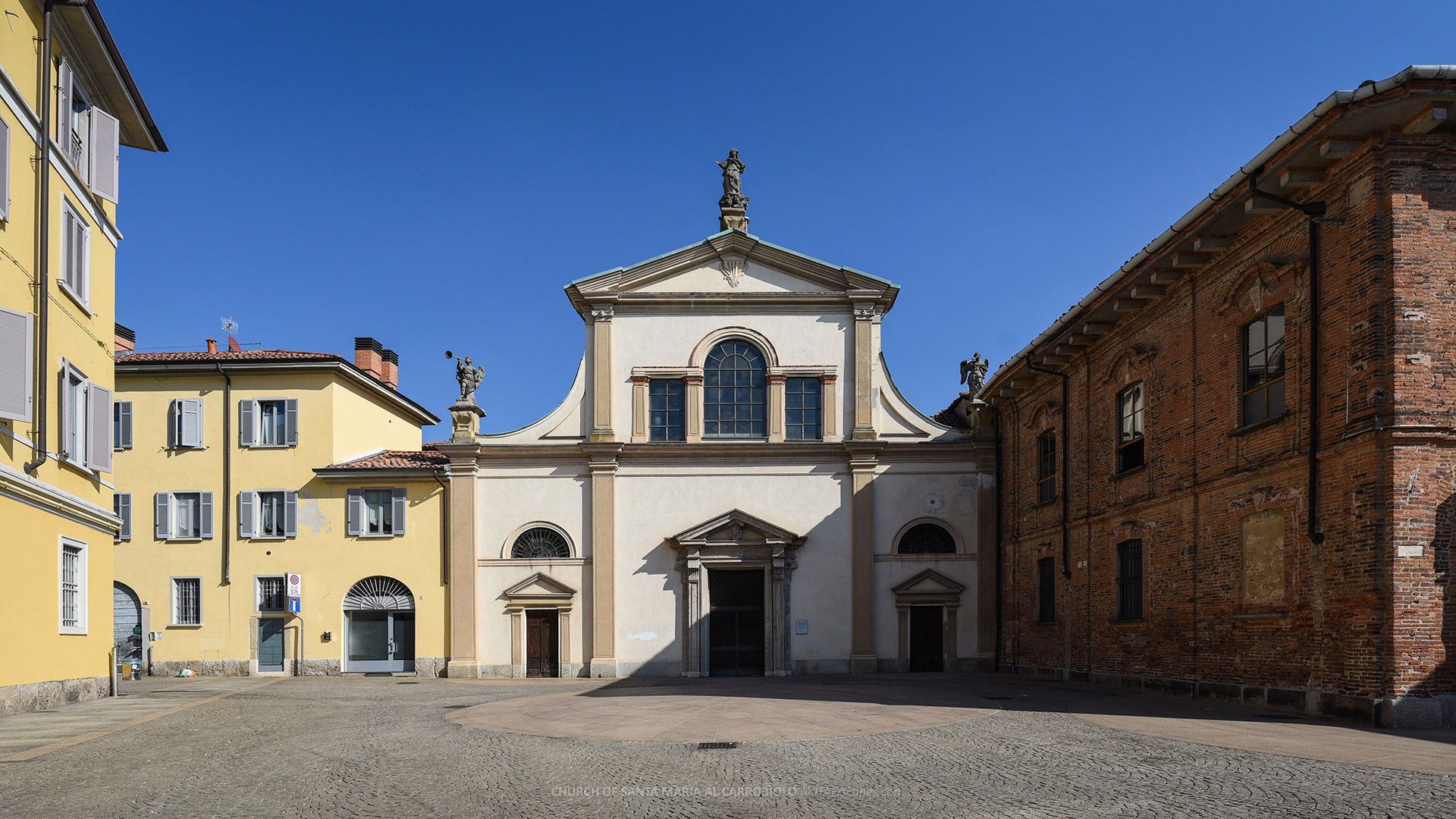
The present façade largely belongs to the 16th-century Barnabite transformation. Its composition was inspired by San Barnaba in Milan, the mother church of the order, designed by Galeazzo Alessi. The architectural language reflects the controlled symmetry and clear proportions associated with the late Renaissance transformation of ecclesiastical architecture in northern Italy.
The façade is organised into two superimposed levels. The lower section is divided vertically by pilasters and contains three entrances crowned by pediments. Above it, the composition narrows to a single central section ending in a triangular pediment, producing a hierarchical arrangement corresponding to the central nave behind it.
One of its most characteristic features is the large Serlian window, completed by Battista Borgonovo in 1581. Its central arched opening and two lower lateral openings provide the upper façade with a strong architectural focus while introducing additional natural light into the interior of the Church of Santa Maria al Carrobiolo.
Later Additions and the Interior
The façade received further decoration during the Baroque period. Giovanni Battista Brunetti created the statue of the Virgin placed above the pediment in 1715, while Carlo Artelli added two flanking angels in 1717. These sculptures introduced a more expressive element without fundamentally altering the earlier architectural composition.
Beside the church stands the Barnabite convent. Its entrance is marked by an elegant sandstone portal completed in 1731 by sculptor Elia Vincenzo Buzzi. Above the doorway appears Saint Paul, a deliberate reference to the Barnabites’ official identity as the Clerics Regular of Saint Paul and to their spiritual patron.
Inside, the central nave is covered by a barrel vault probably constructed before the church was reconsecrated in 1584. This later covering was inserted above the older medieval plan, demonstrating how the building accumulated architectural layers rather than being completely demolished and reconstructed during the Barnabite occupation.
The adjoining complex extends beyond the church itself. It includes a cloister, the convent, an important historic library, and Teatro Villoresi, built in the early 1930s. The theatre later became one of Monza’s established cultural venues, while the library preserves tens of thousands of printed works and manuscripts connected with the Barnabite community.
Art of the Church of Santa Maria al Carrobiolo
Paintings of the 16th and 17th Centuries
The artistic programme of the Church of Santa Maria al Carrobiolo reflects the religious priorities that followed the Council of Trent. Barnabite commissions emphasised clear devotional imagery, recognisable sacred figures, and subjects intended to communicate Catholic teaching directly, while also bringing accomplished Lombard and Piedmontese painters into the Monza complex.
One of the most important artists represented is Simone Peterzano, today also remembered as the teacher of Caravaggio. He received early Barnabite commissions for the church and convent, working within the disciplined religious culture promoted by Carlo Borromeo and the reformed Catholic institutions of the Archdiocese of Milan.
Peterzano’s surviving painting commonly known as Sacra Conversazione or Madonna del Latte shows the Virgin nursing the Christ Child, with the young Saint John offering fruit and other saints arranged around the principal figures. The composition combines formal devotional presentation with a landscape view opening behind the group.
Another Peterzano commission, Glory of All Saints, is associated with the Carrobiolo complex but is now preserved within the convent rather than forming part of the normal church interior. His works at Carrobiolo belong to the Mannerist artistic environment of late 16th-century Lombardy and preceded Caravaggio’s mature career.
Guglielmo Caccia, known as Moncalvo, is represented by two major paintings originally created for the high altar. Adoration of the Magi is now located in the first bay, while Adoration of the Shepherds appears in the fourth bay of the right-hand nave, preserving two important examples of early 17th-century devotional painting.
Frescoes, Sculpture, and Later Decoration
The most extensive decorative intervention inside the Church of Santa Maria al Carrobiolo dates from 1707-1709. Barnabite Invenzio Montalti commissioned a fresco cycle in which Andrea Porta painted the figures, while Giovanni Battista Grandi and Gerolamo Grandi created the illusionistic architectural framework surrounding the narrative and allegorical scenes.
The frescoes glorify the Virgin Mary and Saint Agatha, the two figures historically associated with the church and its original Humiliati community. The combination of painted architecture and figures forms a coherent example of Lombard Barocchetto, using perspective, decorative framing, and illusionistic space to transform the surfaces of the central nave.
Near the entrance connecting the church with the monastery, Giovanni Antonio Cucchi produced angels and an oval image of Saint Charles in prayer in 1762. The location also contains an inscription recalling Carlo Borromeo’s consecration of the church, linking later decoration directly with the Barnabite transformation completed during his episcopate.
The left nave contains the Chapel of Our Lady of Sorrows, repainted by Luigi Morgari in 1926. Its earlier devotional objects include a 16th-century crucifix attributed to woodcarver Battista da Saronno and a 17th-century polychrome wooden statue of the sorrowful Virgin, preserving works from different phases of the church’s history.
Another painting is Marriage of the Virgin by Riccardo de’ Tavolini, a 17th-century artist whose surviving works are comparatively uncommon. Together with Peterzano and Moncalvo, his presence contributes to a collection that documents several generations of sacred painting produced for religious institutions in Lombardy after the Catholic Reformation.
The façade also contains stained-glass windows produced by the Bertini workshop of Milan during later renovation work. The central window represents the Immaculate Conception, while the lateral windows depict Saint Agatha and Saint Barbara, adding another medium to the combination of painting, fresco, sculpture, woodcarving, and architectural decoration within the complex.
A contemporary work entered the church in December 2025, when painter Barbara Badetti’s Annunciation was installed. Its presence continues the long tradition of commissioning religious artworks for the Carrobiolo complex while placing a modern work within a building whose artistic history extends from medieval foundations to the present day.
How to Get to the Church of Santa Maria al Carrobiolo
The Church of Santa Maria al Carrobiolo is located at Piazza Carrobiolo 8, northeast of Monza’s main railway station and close to the historic centre. Travellers arriving at Monza can reach the church easily on foot, while local buses and taxis provide alternatives for passengers with luggage or reduced mobility.
Getting to the Church of Santa Maria al Carrobiolo on foot
The simplest option is walking. Piazza Carrobiolo is approximately 1.1 kilometres from Monza railway station, and the journey normally takes about 14-15 minutes. The short distance makes walking particularly practical for travellers arriving from Milan, Como, Lecco, or other destinations served by Monza’s regional and suburban rail connections.
The route leads from the station toward the historic centre and continues north toward Piazza Carrobiolo. Because the church stands only a few minutes from central landmarks such as Piazza Roma and Monza Cathedral, visitors can easily combine the Church of Santa Maria al Carrobiolo with a walking itinerary through central Monza.
Getting to the Church of Santa Maria al Carrobiolo by bus
Local buses can be useful for visitors who prefer not to walk the entire distance. Line Z206 serves Monza FS – Castello/Turati near the railway station and continues through central Monza toward stops considerably closer to Piazza Carrobiolo, providing a straightforward option on its normal route.
One of the nearest stops is Via dei Mille – Via Mauri, approximately 400 metres from Piazza Carrobiolo and only a short walk from the church. Z206 serves this stop, while other local routes operate through nearby streets, including services around Monza Manzoni/Campini and the wider city centre.
Getting to the Church of Santa Maria al Carrobiolo by taxi
An official taxi rank operates at Monza railway station, making a taxi the easiest door-to-door option for passengers carrying heavy luggage or travelling with mobility limitations. Monza also has a 24-hour radio-taxi service, available through the city’s established dispatch network.
The journey to the Church of Santa Maria al Carrobiolo is short because the church lies only around one kilometre from the station. There is no special fixed station-to-Carrobiolo fare; normal municipal taxi tariffs apply. The city currently sets a €7 minimum fare for a journey including the initial charge under standard tariff conditions.
Frequently Asked Questions about the Church of Santa Maria al Carrobiolo
Where is the Church of Santa Maria al Carrobiolo?
The Church of Santa Maria al Carrobiolo is located at Piazza Carrobiolo 8, Monza, within easy walking distance of the historic centre, Monza Cathedral, Piazza Roma, and the main railway station.
Is there an entrance fee for the Church of Santa Maria al Carrobiolo?
No standard museum-style admission ticket is published for ordinary church access. Special guided visits to the church, convent, or library may have separate participation fees.
What are the most important artworks inside the Church of Santa Maria al Carrobiolo?
Highlights include paintings by Simone Peterzano and Moncalvo, the 1707-1709 fresco cycle, the 16th-century crucifix attributed to Battista da Saronno, and several later devotional works.
Who owns or manages the Church of Santa Maria al Carrobiolo?
The complex remains associated with the Barnabite Fathers, who received it after the suppression of the Humiliati in 1571 and continue their religious and cultural activities there.
-
Photos
-
Map
-
Reviews