-
About
Table of Contents
Piazza Cavour is the principal lakeside square in Como, Lombardy, located along the southern shores of Lake Como, immediately outside the city’s historic centre. Surrounded by elegant buildings, hotels, restaurants, and cafés, it is one of Como’s most important public spaces, offering panoramic views of the lake and the surrounding mountains.
Named after Camillo Benso, Count of Cavour, a leading figure in the Italian unification movement, the square occupies the site of a former medieval harbour. Today, it is a pedestrianized meeting place, an important gateway to Lake Como’s ferry network, and a natural starting point for exploring the city’s historical attractions.
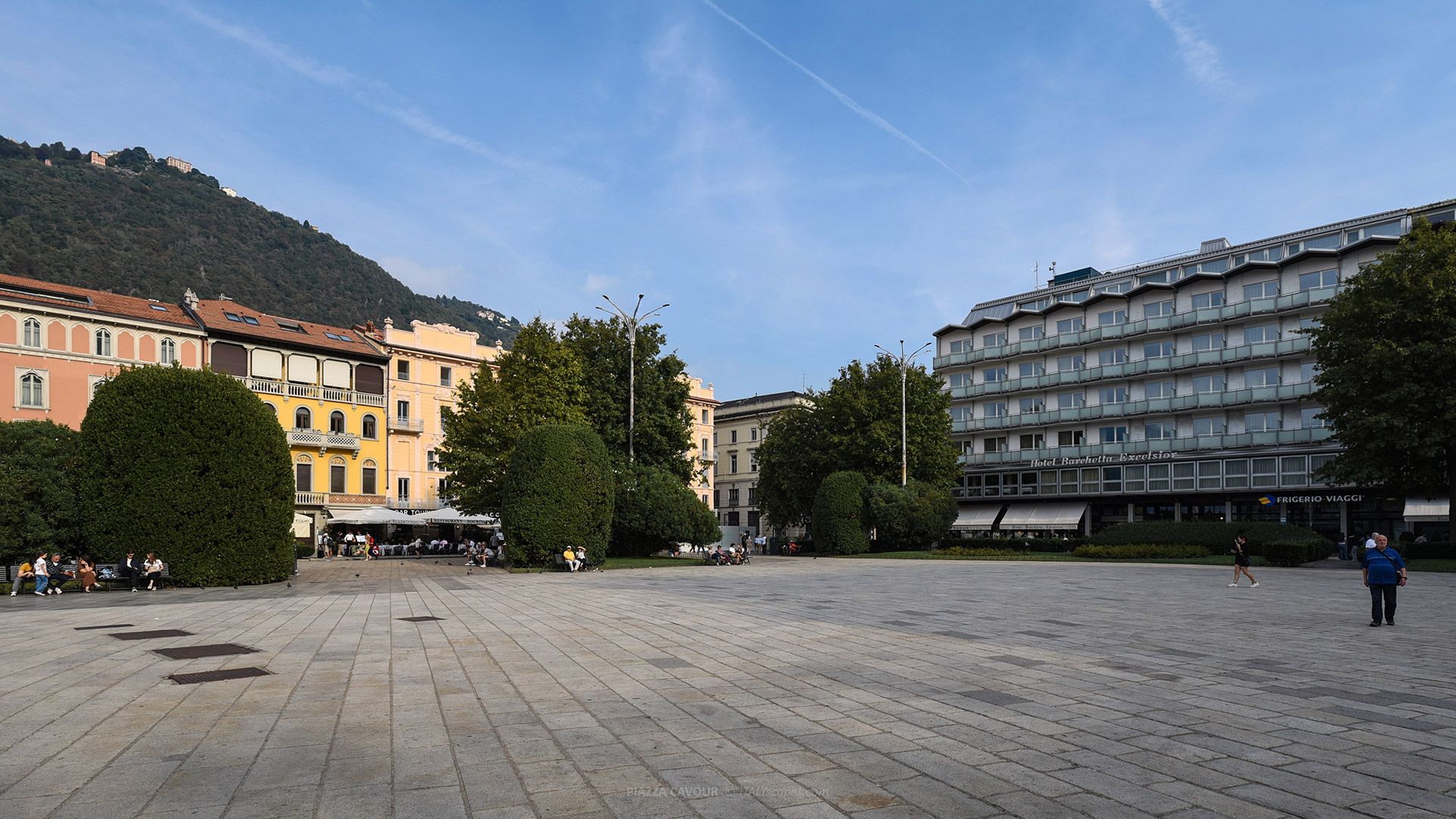
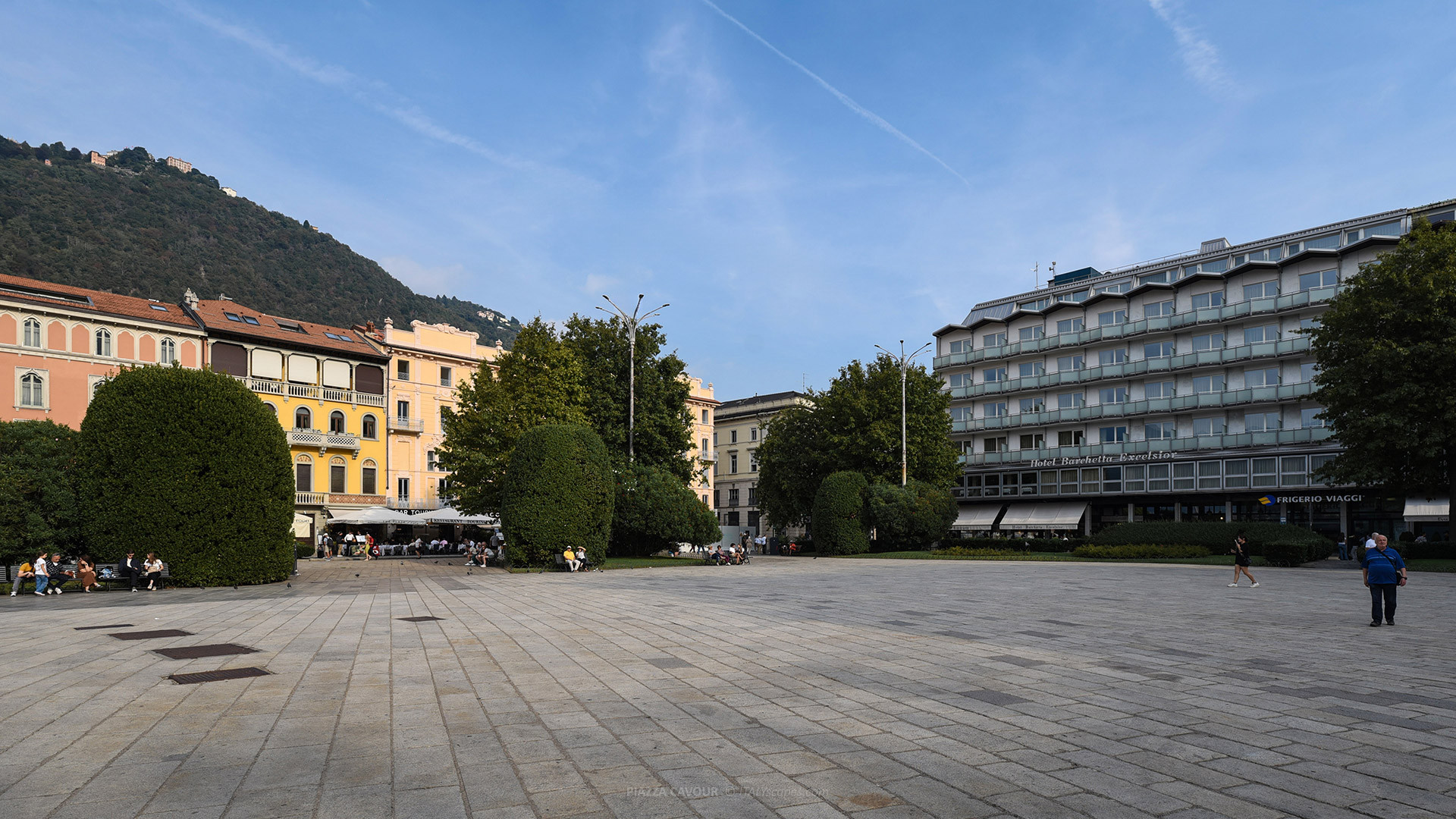
Piazza Cavour in Como, surrounded by historic buildings and hotels.
Short History of Piazza Cavour
From Marshland to Medieval Harbour
During the Middle Ages, the area now occupied by Piazza Cavour was substantially different from its present appearance. The shoreline extended farther inland, creating a low-lying environment characterized by wetlands and shallow water. Its position near the commercial districts of medieval Como gradually encouraged the development of facilities associated with lake transportation.
An important transformation began in 1335, when Azzone Visconti, ruler of Milan and Como, ordered the excavation of a large semicircular harbour. The project was intended to provide additional facilities for merchant vessels, which required suitable landing places for transporting commercial goods across Lake Como and the surrounding territories.
The new harbour was reserved primarily for commercial navigation, while military vessels continued using the fortified port associated with the Cittadella. This separation reflected the importance of maritime transportation to the economy of medieval Como, which maintained extensive commercial relationships with neighbouring towns and communities beyond the Alps.
The harbour developed beside Cortesella, an important medieval commercial district characterized by workshops, warehouses, and buildings associated with local economic activities. Merchant vessels could approach the city directly, facilitating the movement of agricultural products, manufactured goods, and other commodities between Como and settlements situated along the shores of the lake.
The construction of additional infrastructure elsewhere in the region influenced water conditions around Como. In 1336, Azzone Visconti initiated the construction of a bridge across the Adda River at Lecco. By affecting the lake’s natural outflow, the structure contributed to concerns about higher water levels and flooding in low-lying urban districts.
The Transformation into a Public Square
For several centuries, the harbour remained an important component of Como’s transportation infrastructure. Its appearance was recorded in historical illustrations, paintings, and other representations of the waterfront. Among the artists who depicted the city was J. M. W. Turner, whose watercolours included views of Como during the 1840s.
During the 19th century, improvements in maritime technology transformed navigation on Lake Como. Steamboats introduced more regular passenger connections, while commercial transportation increasingly benefited from changes in roads and regional infrastructure. The waterfront consequently underwent a gradual transformation in response to developing economic and social requirements.
The old harbour eventually became unsuitable for the city’s evolving needs. Its enclosed waters created sanitary problems, while the surrounding commercial facilities no longer corresponded to contemporary urban planning priorities. Municipal authorities therefore pursued a programme of land reclamation intended to replace the former harbour basin with a large public square.
The harbour was filled during the second half of the 19th century, producing the open space that became Piazza Cavour. The new square established a direct relationship between the expanding city and the lakefront, replacing the former commercial basin with an area intended for pedestrian circulation and public gatherings.
The square received its name in honour of Camillo Benso, Count of Cavour, one of the principal political figures associated with Italian unification. Cavour served as prime minister of the Kingdom of Sardinia and subsequently became the first prime minister of the Kingdom of Italy in 1861.
The Lost Fountain of Piazza Cavour
One of the most remarkable episodes in the square’s history concerns a monumental fountain installed in 1872. Created by Como sculptor Biagio Catella, the elaborate composition incorporated decorative marine creatures, a swan, and sculptural elements inspired by classical traditions. It also provided drinking water for the city’s inhabitants.
The fountain occupied a prominent position within the newly developed square, becoming an important architectural feature of the waterfront. However, prolonged exposure to environmental conditions caused deterioration, while maintenance expenses became increasingly difficult for the municipal authorities to justify. The fountain was eventually dismantled and placed in storage.
In 1902, American financier William Rockefeller purchased the fountain and donated it to the Bronx Zoo in New York City. The sculpture was transported across the Atlantic and installed within the zoological park, where it acquired a new identity as the Rockefeller Fountain.
The fountain was moved to its present position within the Bronx Zoo in 1910 and received official New York City landmark status in 1968. An extensive restoration completed in 2008 helped preserve the historic sculpture, which remains an unusual surviving connection between Como and New York.
Flooding and Modern Urban Development
The square’s position on reclaimed land has created persistent difficulties associated with flooding. During periods of exceptionally high water levels, Lake Como can overflow onto the surrounding roads and public spaces. Piazza Cavour has historically been among the most vulnerable locations because of its relatively low elevation.
In 2008, extensive works began on a system designed to protect the central waterfront from flooding. The project involved movable hydraulic barriers, underground water-collection reservoirs, pumping equipment, and modifications to the lakeside promenade. Construction experienced substantial delays, technical difficulties, and repeated revisions.
An important phase was completed in 2024, when sections of the renovated promenade reopened to pedestrians. The interventions restored access to the waterfront and introduced improved pedestrian facilities, including additional seating areas and architectural elements integrated into the redesigned lakeside environment.
The hydraulic protection programme continued facing administrative and operational difficulties. In June 2026, heavy rainfall caused renewed flooding near the square, partly because of drainage problems rather than the lake overflowing. Although substantial construction work had been completed, the protection infrastructure had not yet entered full municipal operation.
Architecture of Piazza Cavour
The Layout and Urban Design
Piazza Cavour has a broad, open layout that contrasts with the narrow streets and enclosed spaces of Como’s historic centre. Its northern side faces Lake Como, while the remaining sides are bordered by multi-storey buildings accommodating hotels, businesses, restaurants, and other commercial establishments.
The principal pedestrian area incorporates extensive stone paving, flowerbeds, small trees, and seating areas. These features organize the space without creating substantial obstacles to movement, allowing visitors to cross the square or stop and admire the surrounding buildings and views.
Its open configuration also contributes to the square’s function as a venue for public gatherings. Temporary installations, commercial events, seasonal markets, and cultural activities can occupy parts of the paved surface, while the surrounding establishments provide permanent facilities for visitors and local residents.
The Historic Buildings Surrounding the Square
The buildings surrounding Piazza Cavour represent different periods of urban development, particularly the 19th and 20th centuries. Their façades combine elements of Neoclassical, Eclectic, and more recent architectural traditions, producing a varied composition of windows, cornices, balconies, and decorative surfaces.
Among the most important establishments is the historic Hotel Metropole Suisse, whose origins date to 1846. Situated along the western side of the square, the hotel belongs to Como’s long tradition of hospitality and reflects the development of tourism around Lake Como during the 19th century.
The hotel subsequently underwent architectural and interior modifications, including interventions associated with Giuseppe Terragni during the 20th century. Terragni was among the leading representatives of Italian Rationalist architecture, and his professional activities contributed to the architectural transformation of Como between the two world wars.
Another important building is the Hotel Barchetta Excelsior, located at Piazza Cavour 1. The hotel occupies a prominent position overlooking the waterfront and provides accommodation within walking distance of the principal historic monuments, commercial streets, and public transport connections.
Several other buildings accommodate banks, shops, cafés, and restaurants, maintaining the square’s historical importance as a centre of economic activity. Their ground floors generally contain commercial premises, while the upper levels accommodate accommodation facilities, offices, or other functions associated with the city centre.
The Waterfront and Its Decorative Features
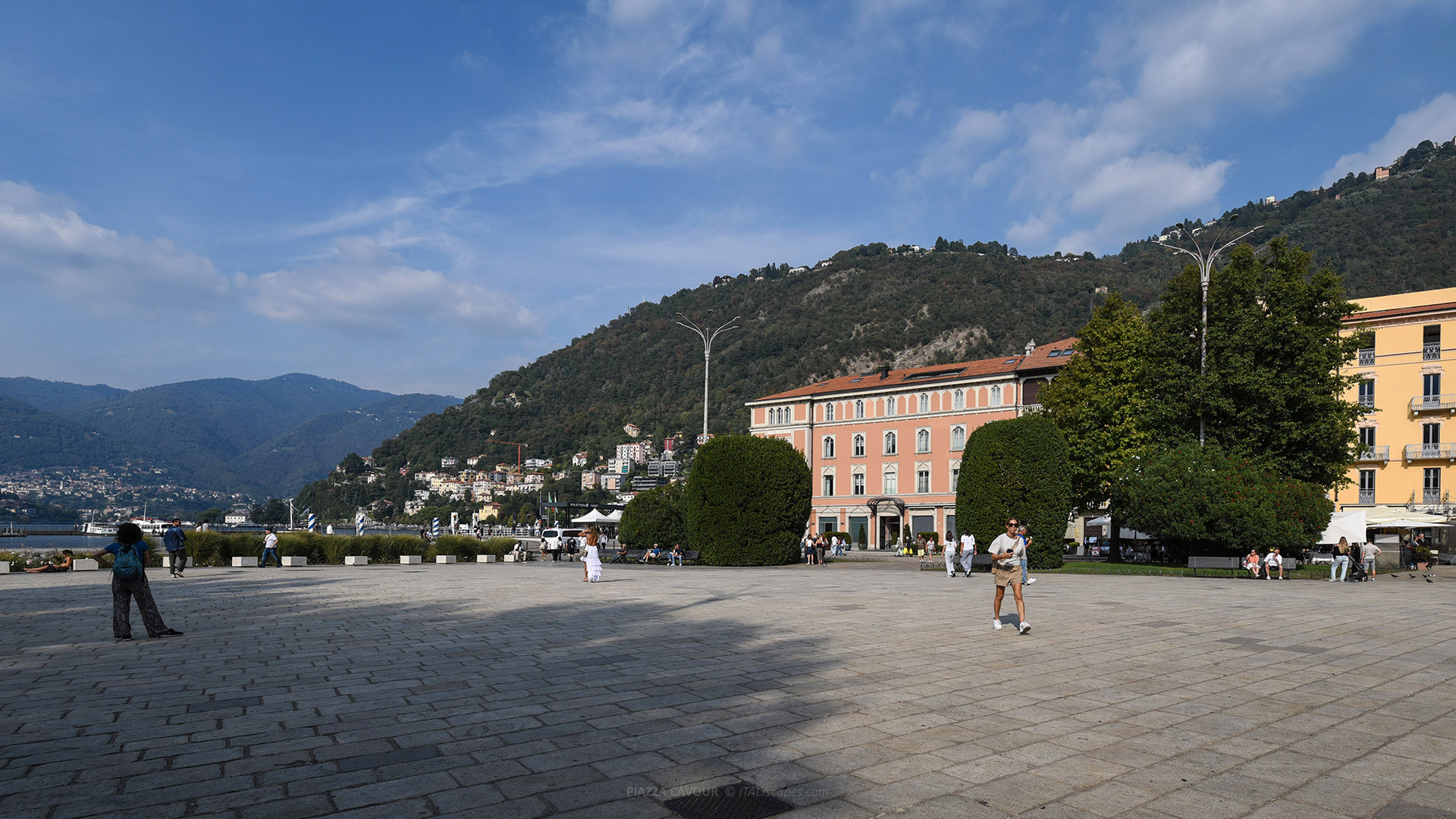
The northern edge of Piazza Cavour opens towards the first basin of Lake Como, offering views of the surrounding hills and waterfront buildings. This position makes the square an important observation point, particularly for visitors interested in photographing the lake and the mountainous landscape beyond the city.
An important feature of the square is the traditional green dragon fountain, a small cast-iron drinking fountain equipped with a characteristic dragon-shaped water spout. Known in Italian as a drago verde, this type of public fountain is particularly associated with the urban landscape of northern Italy.
Flowerbeds and seating areas provide opportunities to rest within the pedestrian zone. The lakeside promenade incorporates additional benches and landscaped features, allowing visitors to appreciate the waterfront without leaving the central area. The arrangement is particularly convenient for people exploring Como on foot.
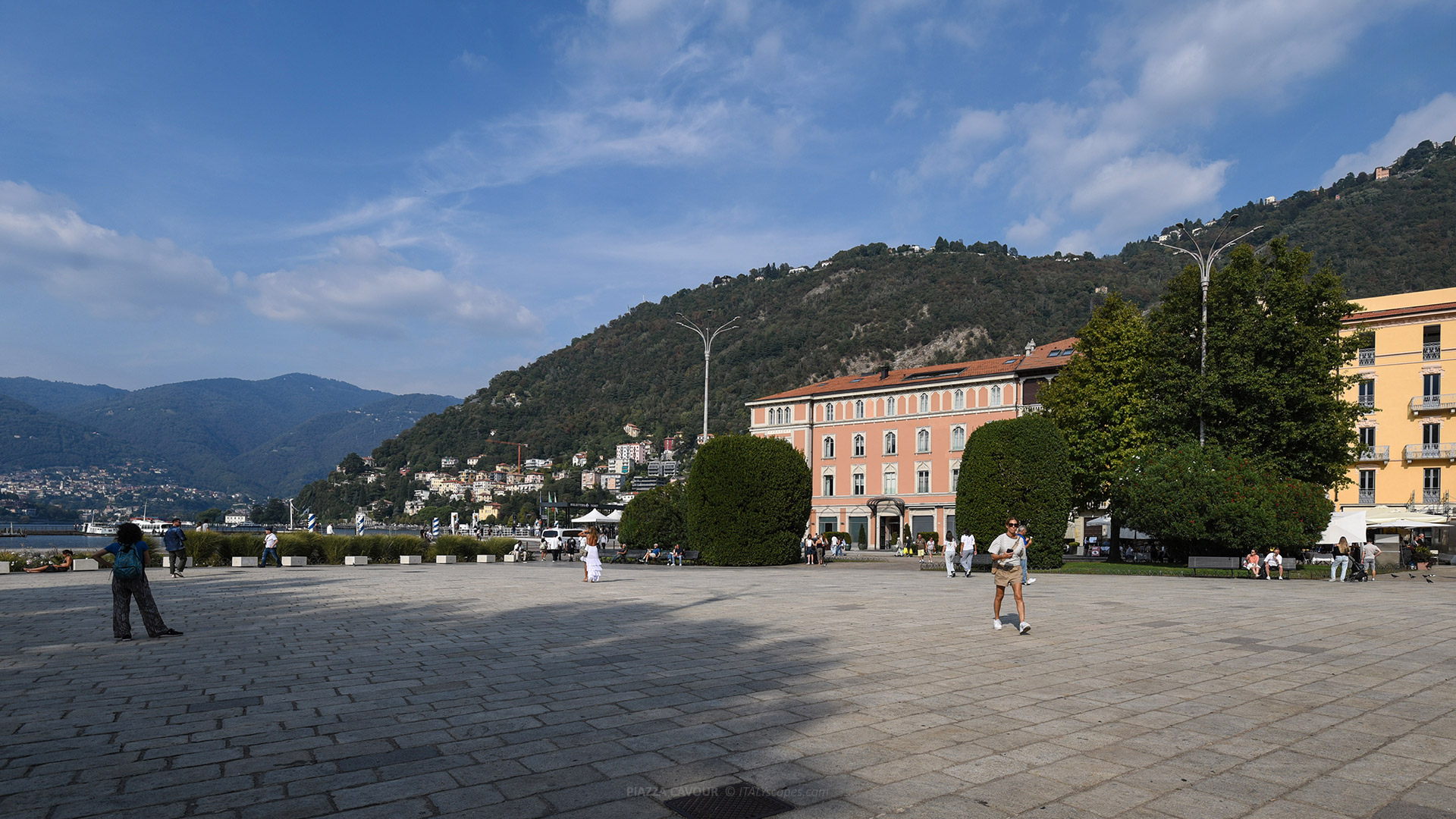
Piazza Cavour in Como, overlooking Lake Como and the surrounding mountains.
How to Get to Piazza Cavour
Piazza Cavour is located immediately beside Lake Como, within easy reach of the historic centre. The square is accessible from the city’s principal railway stations and nearby urban transport stops. Its pedestrianized central area makes walking particularly convenient, although buses and taxis provide practical alternatives for visitors travelling longer distances.
Getting to Piazza Cavour on foot
From Como Lago railway station, the square is approximately 400 metres away, requiring around 5 minutes on foot. Leave the station towards the waterfront and follow Lungolario Trieste in the direction of the historic centre. Continue along the lakeside promenade until reaching the broad pedestrian space overlooking the lake.
Visitors arriving at Como San Giovanni railway station can reach Piazza Cavour in approximately 12-15 minutes. The distance is around one kilometre, depending on the selected route. From the station, follow the streets descending towards the historic centre and continue towards the lakefront through the central pedestrian district.
Getting to Piazza Cavour by bus
Como’s public transport network is operated by ASF Autolinee, which provides urban and regional connections throughout the city and surrounding municipalities. Several bus routes serve the central waterfront, making it possible to reach the square without travelling through the pedestrian streets on foot.
One of the closest stops is Como – Cavour, served by urban routes including N1, N2, N6, and N11. Nearby stops along Como – Lungolario Trento provide additional connections, while the transport facilities around Como Lago offer convenient transfers between different services.
Getting to Piazza Cavour by taxi
Licensed taxis are available from designated ranks around Como, including the area outside Como San Giovanni railway station. The journey to Piazza Cavour generally takes approximately 5-10 minutes, depending on traffic conditions, the selected route, and access regulations affecting the central waterfront.
Passengers should specify Piazza Cavour, Como as their destination. Since the central square is pedestrianized and adjoining streets may be subject to limited-traffic regulations, drivers must use authorized stopping areas. Visitors can then continue towards the lakefront on foot, generally requiring only a short walk.
Frequently Asked Questions about Piazza Cavour
Where is Piazza Cavour located?
Piazza Cavour is located on the central waterfront of Como, Lombardy, northern Italy, immediately beside Lake Como and within walking distance of the historic centre.
Why is Piazza Cavour famous?
The square is famous for its lakefront views, historic buildings, cafés, restaurants, and proximity to ferry services. It is one of Como’s principal public gathering places.
What was Piazza Cavour originally used for?
The site originally contained marshland before becoming a medieval commercial harbour. During the 19th century, the former harbour was filled and transformed into a public square.
Who is Piazza Cavour named after?
The square commemorates Camillo Benso, Count of Cavour, an important Italian statesman who played a central political role in the unification of Italy during the 19th century.
What happened to the original fountain of Piazza Cavour?
The monumental fountain created by Biagio Catella in 1872 was purchased by William Rockefeller in 1902 and transferred to the Bronx Zoo in New York.
Can you take a boat from Piazza Cavour?
Yes. The nearby Navigazione Laghi landing stages provide public passenger services connecting Como with several lakeside destinations, including Bellagio, Menaggio, and other towns.
-
Photos
-
Map
-
Reviews